Natural slate Samaca
02december
Natural slate Samaca - the history of shale quarries

Natural slate has been used for centuries as a reliable and durable roofing material. The waterproofness of a shale-covered roof is achieved thanks to the high qualifications of roofers, who have honed their skills for centuries and passed their knowledge from generation to generation; in some countries, this way whole generations and dynasties of roofing masters were formed.
Slate is a fire-resistant, non-porous and environmentally friendly stone with many natural features that make it one of the most valuable building materials on the construction market. In Europe, most slate roofs have a lifespan of more than 100 years, and in England there are slate roofs over 200 years old and they are still in excellent condition, only wood is thin and requires replacement. Often, slate after reconstruction is reused on other less significant projects.

Natural slate
Formed natural slate, like all other shale, is a metamorphic rock, which means that the first stone has undergone a chemical transformation to become a finished product. Possessing similar properties with sedimentary rocks, the shales were compressed and heated for thousands of years, the clay in the slate was destroyed and turned into the so-called mica.

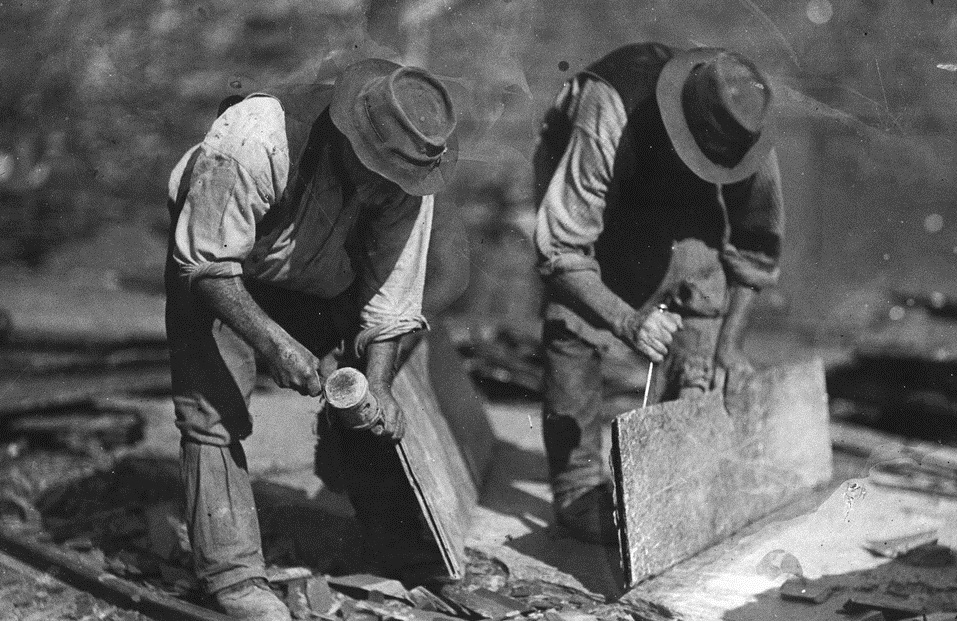
Mica, from the Latin word “micare”, allows the newly formed stone to crack along the plane. This is one of the properties that allows you to manually split large shale billet by hand using only a hammer and chisel. Slate also contains quartz, the high level of which contributes to the brilliant appearance of the slate that shimmers in the sun.

The geological location and chemical composition determine the different color and density of the slate. Gray shale predominates in the European geological fault, and in England and America there are deposits of slate of different colors (purple, red, green, etc.), but their reserves are limited.

All shales contain iron pyrites, nicknamed “fools of gold” for their misleading appearance, they are iron sulfides that are either “stable” or “unstable” in terms of shale makeup.
Stable pyrites underwent tremendous temperature and high pressure and, thus, crystallized, forming small clusters in the stone similar to gold particles.

Unstable pyrites, were subjected to less heat and pressure, therefore, they did not fully crystallize, and remain vulnerable elements in the structure of the stone.
Unstable pyrites will necessarily have the effect of the so-called "bleeding", the formation of rust on the surface of the slate, creating a trace of an ugly rusty drip.

Unstable pyrites, besides the fact that they are an eyesore, actually destroy and compromise shale roofing or any other surface where poor quality slate was used.
Samaca slate - quarrying.
The first step taken before the extraction of shale is the removal of the upper layer of the shale surface or “overburden”, which is sometimes hundreds of meters in depth. The upper layers of the quarry are exposed to external elements for millions of years and, thus, the upper deposits are disturbed or the surface of the shale deposits is otherwise compromised. Once the unusable slate is removed from the upper layer, experts and engineers will be able to determine the quality of the stone in the main deposits of the mining site.

As soon as the quality of the slate is determined and it is positive, that is, in accordance with technical standards, the extraction of the desired material may begin. Using diamond-beaded steel cables, large stone slabs are cut from the sides of the mountain, creating staircases.

With the help of special equipment, large stone slabs are split into smaller ones, for transportation to the Samaca factory. Shale quarries generally have open mining, although underground mining is still underway.

These huge slabs are then transported to the Samaca plant, where they are cut into smaller blocks, their size depends on the size of the tile to be made. Despite the fact that slates come from the same quarry, they can be divided into several categories according to the splitting property.

After sorting shale blocks, the conveyor separates and distributes them according to the quality category.

Samaca slate tiles.
Shale splitting occurs manually, using only a hammer and a chisel, and skilled craftsmen at the Samaca factory split the stone to the desired thickness.

To complete the process, the slate plates are passed through a machine that sets the exact dimensions and beats the edges.

Finished products in the Samaca factory are packed in wooden pallets for transportation to the destination. The size of the slate, its thickness, classification and quantity indicate on the packaging frame.

Natural slate Samaca and other slates, in the European sense and not only, is considered one of the most environmentally friendly building materials, mainly due to its minimal processing during production. This means that the minimum amount of equipment involved in its production and production, compared with other types of production and production of building materials.
Manual shale splitting and minimum factory sawing ensure minimum CO2 emissions. In all the processes of production of Samaca slate, the factory uses water and electricity that does not harm the environment.
